Release Notes - v1.0.1
Summary
The first feature release after v1.0.0 sharpens three areas: the AI Assistant, security, and AI model control. The chat assistant can now filter candidates by years of experience and generate a shortlist of a job's top applicants in a guided flow — backed by a new experience field extracted from every CV so the filter works on any model. Chat itself got a major reliability and UX pass: history search, rename, and delete, a stall-recovery watchdog so a stuck model response no longer hangs forever, per-chat model persistence, and plain-language model labels. On the platform side, this release ships two batches of security hardening — multiple IDOR fixes, stored-XSS patches on offer letters, AI-SQL tenant isolation, webhook signature verification, and a production guard on a test endpoint — plus per-company S3 storage isolation. Recruiters also get per-module AI model selection (choose a different model for CV review, job posting, scheduling, behavioural analysis, and more — including a Taqat-hosted Qwen model), a visible scoring rubric, selective CV download as a ZIP, background suggested-candidate matching with live progress, deferred rejection emails until a job closes, and a reaper that auto-recovers and retries CV uploads that were silently killed mid-process. Outgoing emails are now branded Truepick.
What's New
- AI Assistant: experience filter + shortlist generation — the assistant can now honor "exclude candidates with more than N years of experience" and generate a ranked shortlist of a job's applicants, persisting the top-N as shortlisted via a two-step preview/save confirmation
- Per-module AI model selection — pick a different model per operation (chat, CV review, interview, assessment, jobs), including a Taqat-hosted Qwen custom model; all modules default to GPT-5 Mini
- Chat history management — search, rename, and delete past conversations
- Stuck-upload auto-recovery & retry — a reaper fails CV jobs stuck with no progress for >15 minutes and a one-click Retry re-queues only the unfinished files; no more permanently spinning uploads
- Visible scoring rubric — recruiters can see how an interview score is built (scale, dimension weights, per-question vs holistic rollup), shown additively so older evaluations render unchanged
- Selective CV download (ZIP export) — select candidates and download their CVs as a single streamed ZIP
- Background suggested-candidate matching — matching runs in the background with live activity progress instead of blocking
- Deferred rejection emails — candidate rejection emails are held and sent only when the job is closed
- Assessment anti-cheat — paste is blocked on text answers and question text can no longer be copied
- Redesigned Import Candidates dialog — location/skills filters, already-applied candidates excluded, duplicate flags, and a confirmation step
Improvements
- Chat stall recovery — a client-side timeout and recovery prompt surface and retry a stuck AI response instead of hanging indefinitely
- Per-chat model persistence — the selected model is remembered across chats via a secure cookie, with plain-language labels and i18n loading strings
- Chat input character counter — live counter with a 2,000-character client-side limit
- Multi-tool replies summarize — the agent step limit was raised so multi-tool chat replies return a final summary instead of cutting off
- Recruiter-facing chat cleanup — token-usage telemetry hidden from recruiters; assistant tool links use relative URLs; date-range candidate analytics and open-job listing added
- AI interview settings on job detail — the configured interview settings are now displayed on the job detail page
- Consistent back button — a shared back button across recruiter detail pages
- Register/login validation — name and email validation errors surface inline, a TLD is required on email, and Confirm Password has a show/hide toggle; login honors the original `redirectUrl`
- Interview integrity score — now reflects behavioral concerns instead of staying optimistic
Security
- IDOR fixes — company ownership enforced on candidate update, upload history, offer-letter download, and the S3 file proxy
- Offer-letter stored XSS — user fields escaped in offer-letter HTML (two sinks closed)
- AI SQL tenant isolation — the AI SQL tool is scoped to the caller's company, with a comma-join bypass closed
- Webhook signature verification — Fireflies and Composio webhooks now verify signatures before processing
- Private job endpoints — auth required, deny-by-default for private `/api/jobs` routes
- Production guard — the test Inngest-trigger endpoint is blocked in production
- Auth-bypass / path-traversal batch — an OTP auth-bypass, chat path-traversal, and additional IDOR holes closed
- Per-company S3 isolation — all company-owned uploads scoped to a `companies/{companyId}/...` namespace
Reliability
- Bulk CV ZIP streaming — large CV ZIP exports are streamed to prevent worker out-of-memory
- One active application per candidate per job — enforced at the database level
- Applicant counts reconciled — status counts now sum to the total; `review_done` is included in the Interviewed count
- Candidate-search render loop fixed — eliminated an infinite re-render on candidate search
- Recording access hardened — presigned URLs replace public ACLs; egress auto-detects LiveKit Cloud vs self-hosted credentials; video is downloaded to a temp file before FFmpeg
- Incomplete interviews skipped — interviews with no answered questions are no longer scored, and behavioural writes no longer clobber the evaluation
- Arabic CV parsing — Arabic Presentation Forms are accepted by the PDF text-meaningfulness check
- Truepick email branding — outgoing emails rebranded from "Taqat Recruitment" to Truepick, with the logo inlined via CID so it stops 404ing in clients
AI Assistant: Experience Filter & Shortlist Generation
Ask for "under 15 years" and get a real shortlist
The chat assistant previously could not honor a request like *"exclude candidates with more than N years of experience"* on any model — candidates had no numeric experience field, and the scoring tools reported job-count as if it were years of experience.
What changed:
| Area | What's new |
|---|---|
| Reliable signal | A `totalYearsExperience` value is now extracted from the CV at ingest (and persisted across apply, re-upload, and create-candidate), with a resolver that falls back to the AI review's total years or flags "experience unknown" |
| Filtering | `minYears` / `maxYears` filters added to candidate listing; unknown-years candidates are kept and clearly flagged rather than silently dropped |
| Correctness | Match-candidates, deep CV analysis, and semantic search now use the real experience value instead of a job-count stand-in |
| Shortlist | A new shortlist tool ranks a job's applicants, applies the years filter, and persists the top-N as shortlisted via a two-step preview/save confirmation |
The assistant works the request agentically — discovering the job, listing applicants, and ranking them — then persists the chosen candidates as shortlisted once you confirm.
Per-Module AI Model Selection
Choose the right model for each job
AI Settings now lets a workspace pick a different model for each AI operation instead of using one model everywhere.
| Capability | Details |
|---|---|
| Per-module models | Independent model choice for Chat & assistant, Candidate & CV, Interview, Assessment, and Jobs |
| Taqat Qwen | A Taqat-hosted Qwen custom model — private and hosted in-house — is available as an option |
| GPT-5 Mini default | All modules default to GPT-5 Mini |
| Request logging | LLM requests are logged for observability |
| Qwen-safe generation | Job-posting generation was hardened so reasoning-style models return valid JSON; behavioural analysis is pinned to a vision-capable model |
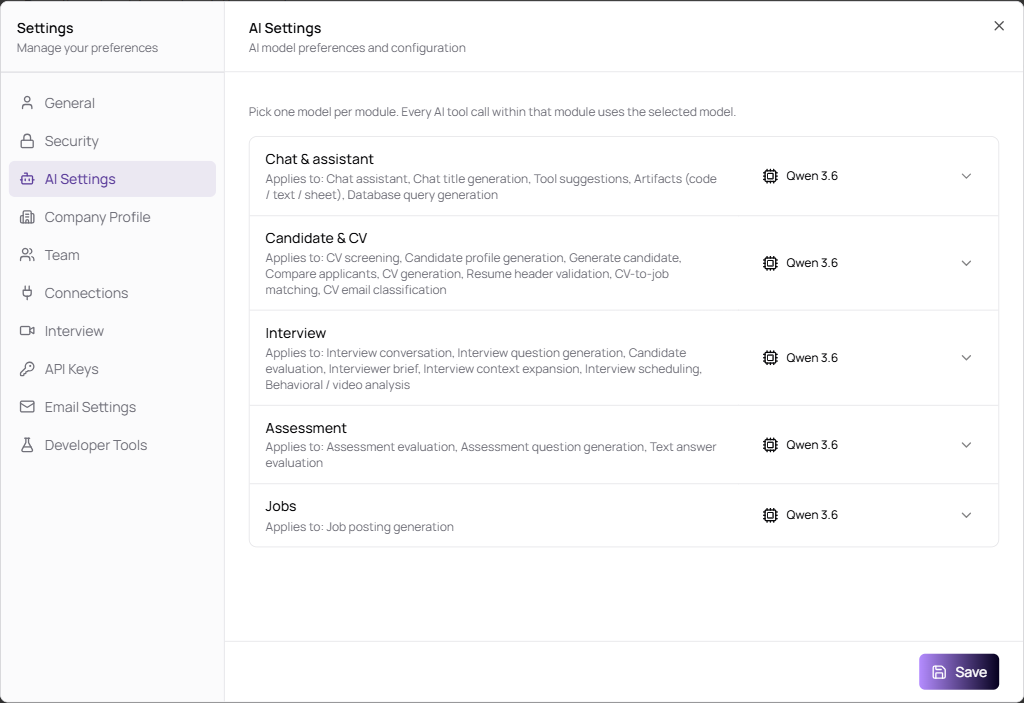
Settings → AI Settings: pick one model per module — every AI tool call within that module uses the selected model
Chat Reliability & UX
A faster, calmer assistant
| Improvement | What it does |
|---|---|
| History management | Search, rename, and delete past conversations |
| Stall recovery | A client-side stall timeout plus a recovery prompt surface and retry a stuck AI response instead of hanging forever |
| Model persistence | The selected model is remembered across chats via a secure cookie |
| Plain-language labels | The model selector uses human-readable labels and descriptions, grouped by provider, with localized loading strings |
| Character counter | Live counter with a 2,000-character client-side input limit |
| Multi-tool summaries | The agent step limit was raised so multi-tool replies return a final summary |
| Recruiter-friendly | Token-usage telemetry hidden from recruiters; assistant tool links use relative URLs; date-range candidate analytics and open-job listing added |
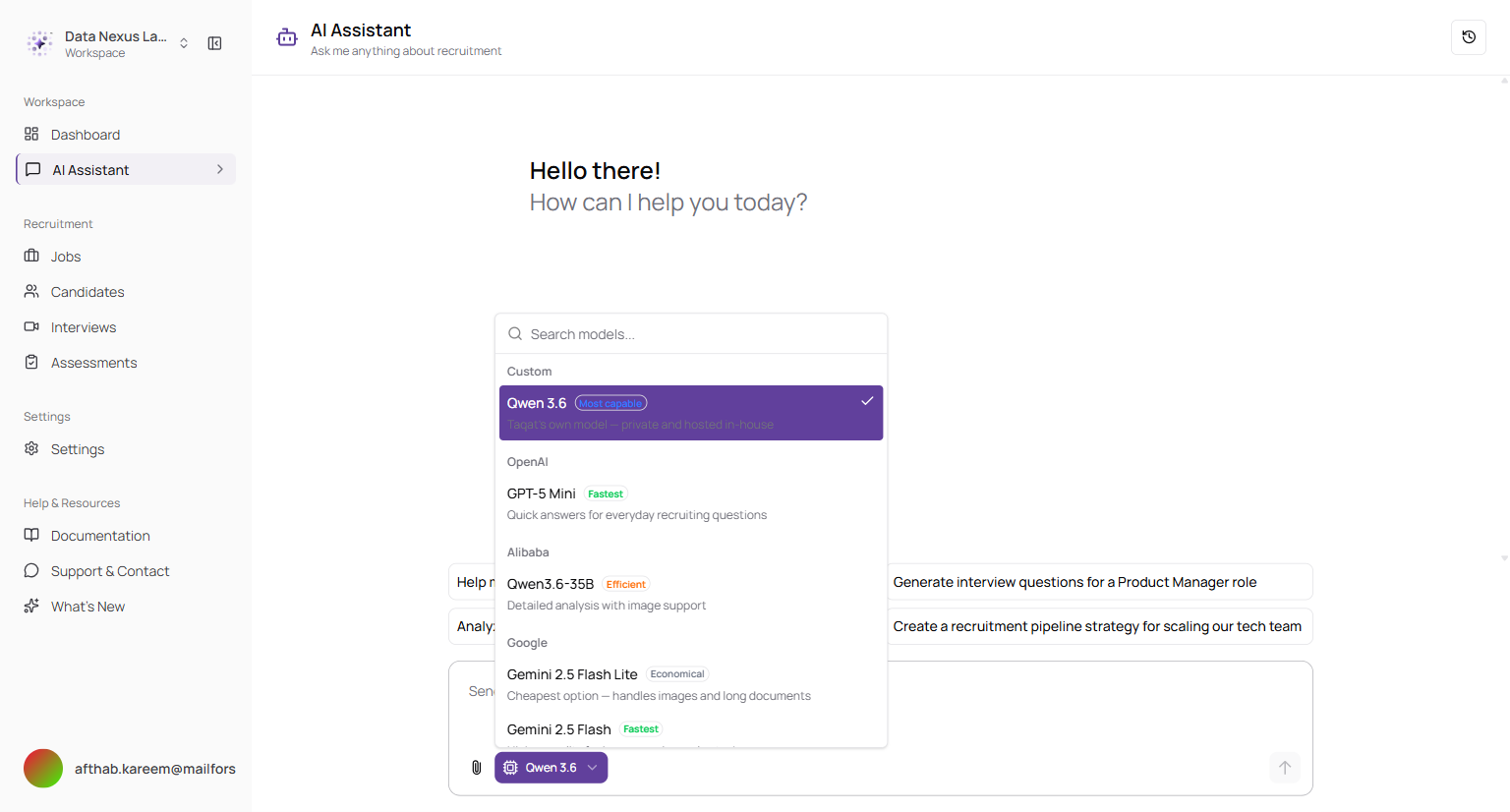
The model selector now shows plain-language names and descriptions grouped by provider
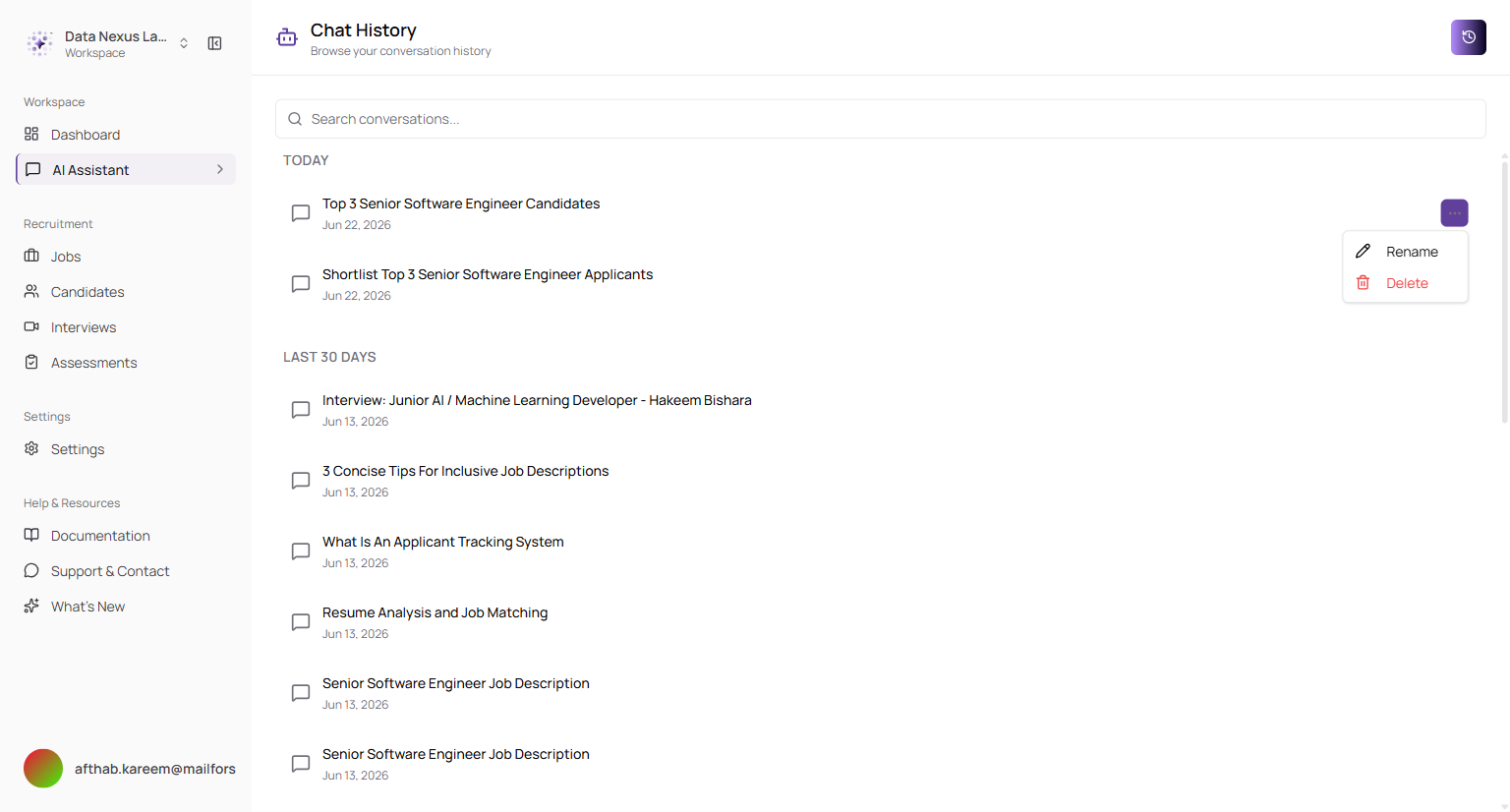
Chat History — searchable, grouped by date, with rename and delete on every conversation
When a model response stalls, the assistant no longer hangs — it surfaces a recovery prompt so you can retry in place.
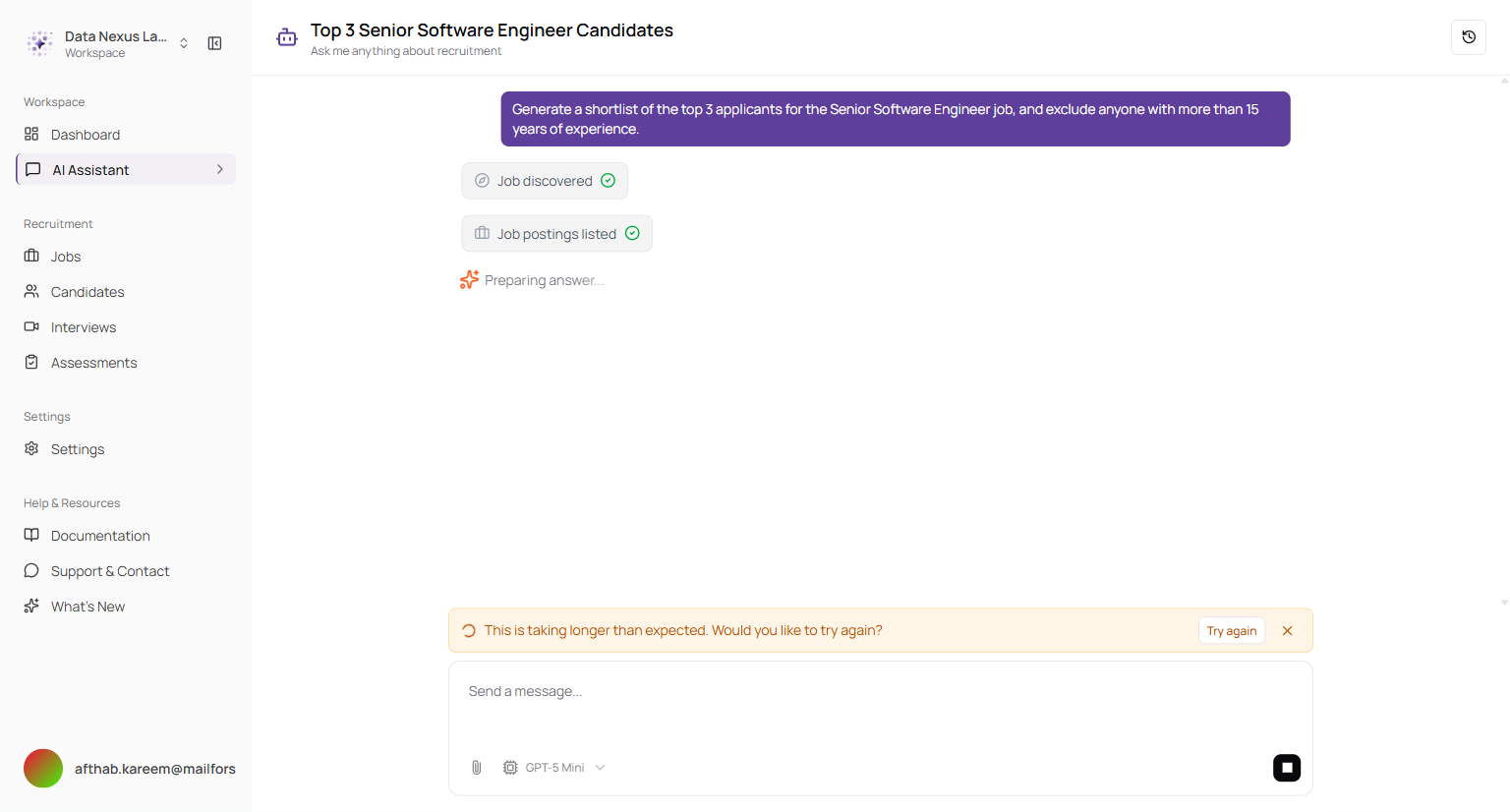
If a response takes too long, a "taking longer than expected — Try again" control appears instead of an indefinite spinner
Stuck-Upload Auto-Recovery & Retry
No more permanently spinning uploads
When a background CV-processing function was silently killed mid-step (server redeploy, out-of-memory, AI-credit exhaustion), its failure handler never ran — leaving the upload stuck in "processing" forever with no way to cancel or retry.
- Reaper (every 3 minutes) fails jobs stuck in "processing" with no progress for more than 15 minutes, cleans up open steps and bulk-upload items, and broadcasts the change over SSE so the UI leaves the spinner
- Unified manual retry — a tenant-scoped retry endpoint, capped at 3 attempts via a race-safe conditional update; bulk re-queues only the non-successful files under the same tracking row
- Retry surfaced on failed batches in the upload-center widget (Cancel already existed)
Visible Scoring Rubric
See how the score is built
The candidate evaluation view now exposes the AI scoring methodology so recruiters can understand and defend a score:
- A collapsible "How We Score" panel — scoring scale, why the interview dominates, what the other dimensions add, and why a random question subset is intentional
- A rubric breakdown — grade scale legend, dimension × weight contribution table, and the 75% per-question vs 25% holistic interview rollup
The rubric is wired in additively — older evaluations without the new fields render exactly as before, and a per-question rubric is hidden for legacy evaluations that lack the asked-question flag.
Jobs & Candidates
Cleaner intake, accurate counts
The redesigned Import Candidates dialog adds location and skills filters, excludes candidates already on the job, flags duplicates, and confirms before importing.
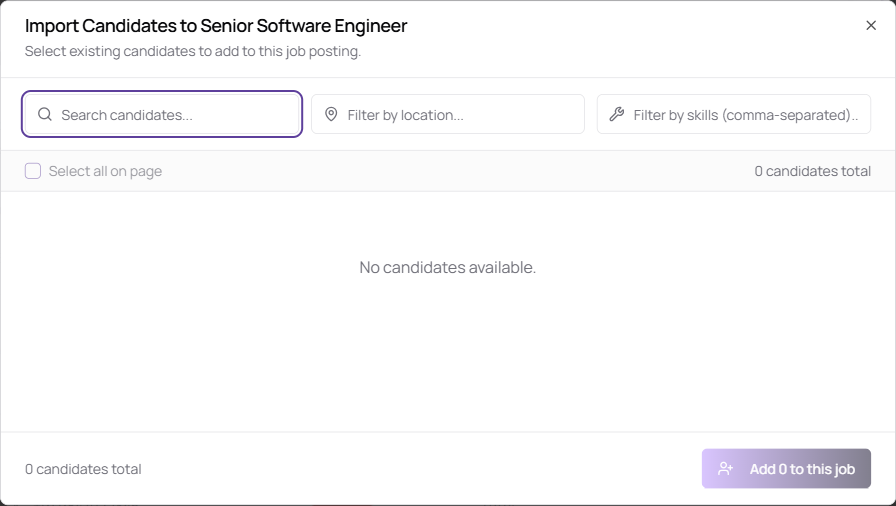
Import Candidates — search plus location and skills filters, with select-all and a clear import action
Applicant status counts now reconcile to the total, `review_done` is counted as interviewed, and the applicants toolbar carries selective Download CVs (ZIP), Compare, and Refresh.
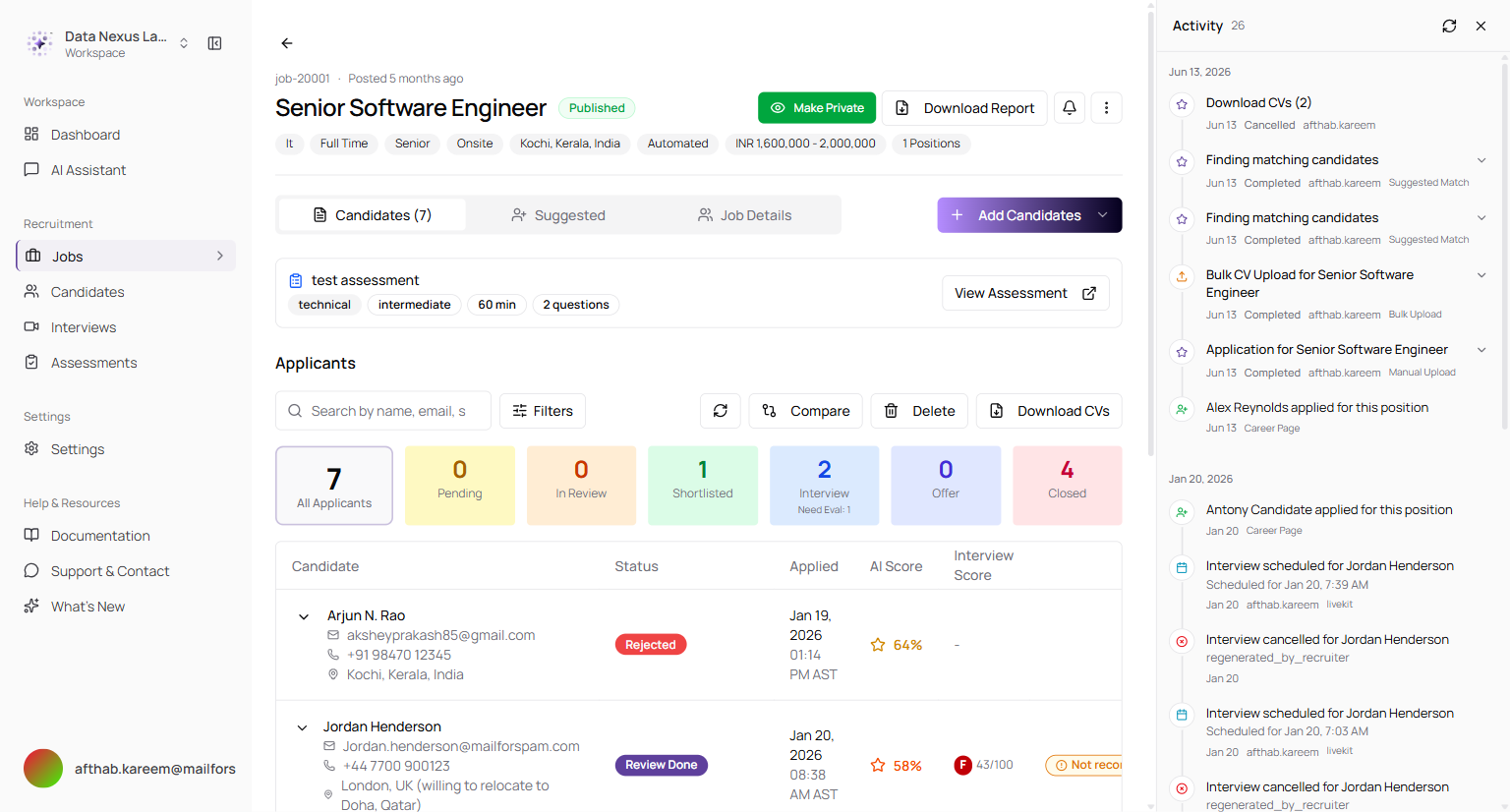
Applicants overview — status cards that sum to the total, interview-score grades, and Download CVs / Compare / Refresh actions
Other changes: one active application per candidate per job (DB-enforced), serial numbers unique per company, background suggested-candidate matching with live progress, and assessment anti-cheat (paste blocked on text answers, question text non-copyable).
Security Hardening
Two batches of fixes
| Area | Fix |
|---|---|
| IDOR | Company ownership enforced on candidate update, bulk upload history, offer-letter download, and the S3 file proxy |
| Stored XSS | User-supplied fields escaped in offer-letter HTML (two sinks closed) |
| AI SQL | The AI SQL tool scoped to the caller's company; a comma-join bypass closed |
| Auth | Auth required on private user job endpoints; deny-by-default middleware for private `/api/jobs` routes |
| Webhooks | Fireflies and Composio webhook signatures verified before processing |
| Prod guard | The test Inngest-trigger endpoint blocked in production |
| Auth-bypass batch | OTP auth-bypass, chat path-traversal, and additional IDOR holes closed |
| S3 tenant isolation | All company-owned uploads scoped to a `companies/{companyId}/{type}/...` namespace, with legacy keys still authorized by per-type ownership checks |
Reliability & Other Fixes
| Area | Change |
|---|---|
| Performance | Bulk CV ZIP export streamed to avoid worker OOM; job-analytics active-count query bounded; candidate-search render loop fixed |
| Recordings | Presigned URLs instead of public ACLs; egress auto-detects LiveKit Cloud vs self-hosted; video downloaded to temp before FFmpeg; retry when a recording isn't ready yet |
| Interviews | Incomplete interviews are not scored; behavioural writes no longer clobber the evaluation; integrity score reflects behavioral concerns |
| Auth | Inline name/email validation on register, TLD required, Confirm Password show/hide toggle, login honors `redirectUrl` |
| CV parsing | Arabic Presentation Forms accepted by the PDF text check |
| Rebranded to Truepick with an inline CID logo; SMTP secure-connection toggle label clarified; rejection emails deferred to job close |
Released on June 22, 2026
View all releases